Report (Jesse Smith) - DistroWatch Weekly, Issue 348, April 5, 2010
 One of the fascinating things in the open source software is its adaptability to various and many tasks never before explored. Linux, with its flexibility, it is usable in many different areas. Take an example, Asturix . Asturix Project is an attempt to make a better operating system for the world in general, but as for English speakers. The project recognizes that Linux users often need to interact with applications and networks are not always open source, and friendly. This project has been adapting its offer to make these situations, something more simple. And to achieve these objectives, Asturix has created three editions of its distribution.
- Business or Business: For use in office;
- Desktop or Desktop : Aimed at a homestyle
- Lite : Designed taking into account the older equipment.
Business and Desktop editions have their variants 32 and 64 bits. And, to my experience, I decided to try Asturix Business or Business. The DVD of this edition weighs alrrededor of 1.2 Gb, and while downloading it, I had time to look at the project website. By default, the site language is English, but there is a wide range of translations into languages \u200b\u200bsuch as English, French, German, Italian, Portuguese and Russian. In addition to addressing the objectives of the project and offers downloads, the site also offers a wiki (mostly in English), a forum, a news section and a contact form. The Navigation is easy and in regard to design, is a brilliant combination, very nice white and green.
Live mode and system installation
When starting the Live DVD, obviously feels at Asturix a taste of Ubuntu. The boot menu is very similar, although, in my opinion, the selection of any love of the English language, does not alter the text in the boot options. The menus at the bottom of the screen have changed but not the central menu. The DVD boot in Live mode, it checks for errors in the installation media and communication, or start an OEM installation. By choosing the exploration of real-world environment first, offered me A welcome screen, which reminded me the Northern Lights. one minute later came the GNOME menu. In terms of design, this is very similar to that of Ubuntu, with the menu bar at the top of the screen, but the angry brown and orange have been replaced with bright, cheerful colors, blue and green. After looking a bit, I decided to install Asturix , but was not able to find the installer forced me to restart, and in the start menu choose run the installer.
To install, Asturix , the system uses the Ubuntu installer, so this process becomes simple and without surprises. A user will be asked to select the language preference local time and the distribution of your keyboard. The user is responsible for creating partitions and select a password for the account. It is an easy and painless experience, love to take very little time to complete.

Asturix 2.0 - the use and management of Screenlets (The image at full size: 595kb, screen resolution of 1366x768 pixels)
Applications
One of the first things that probably will who comes first this note on the desktop distribution Asturix screenlets collection is on the right side of the screen. There is also a search bar for Google, a notepad, a calendar and an analog clock. Some people find this very useful, others see it as an extra clutter. Unfortunately, I do not remember if I've been getting screenlets reappear in every new session or unless it has been disabled from the startup utility applications.
In regard to the list of available programs, we have: Firefox 3.0 for web browsing, Evolution for email, the softphone Ekiga and Pidgin for instant messaging, BitTorrent client, OpenOffice.org, an audio player and a disc burner. Asturix also comes equipped with graphics software such as GIMP, F-Spot and Cheese Webcam tool. GnuCash is also offered, also Java and WINE. The distribution also comes equipped with a wide range of configuration tools to adjust the appearance of the system and the feeling that this may emanate, manage user accounts, manage and install software drivers.

Asturix 2.0 - change the configuration and web browsing (full image size: 595kb, screen resolution of 1366x768 pixels)
Most applications, as well as their entries in the menu respond to the configuration of the language. Although there are some exceptions. In the system of tools within the secondary menu, we find a collection of specific programs of the screen of Asturix in English. There, the first point, is an update tool, and although my English language skills is not very large, I believe that this utility is designed specifically for an upgrade from a previous release version. But as I was already using the latest version, I was not able to serve this program. The next item is a CD / DVD that works perfectly.
The third program is for installing applications, and that caused me a disappointment. The installer has two tabs, the first is for the installation of 'extras', such as Java, Flash and codecs. In the edition "Business or Business" all these packages already installed by default, making it unnecessary to download. The second tab is a list of categaorias software such as graphics, Internet and Multimedia. She asks the user to select one. Clicking on one of the option off later, the system prompts the user password sudo y. .. Then no worries. No activity in the network, which makes me think it's a bug in the software or, perhaps!, May be all already installed in the Business edition. The problem is that it is hard to know for sure, since there is no message appears as indicated. Another place where the user is in English, irrespective of the configuration of your system is on the screen "Help." Among other things, the documentation provided, the instructions on the installation of new software, antivirus, office document management, but there is no explanation about screenlets. Whenever
is based on Ubuntu, Asturix , uses APT and its family of related tools for package management, this includes Synaptic. The software is extracted from the Ubuntu repositories, giving the user more than 26,000 packages available. This feature, makes a Asturix compatible with other versions of Ubuntu. It is noteworthy that during my time with Asturix I had no problem to install, remove or upgrade software, Synaptic and running quickly, as usual!.
The
Hardware For my experience with this OS, I used two machines. A desktop with a generic CPU 2.5 Gb of RAM and an NVIDIA graphics card. The other was my HP laptop that boasts a 2-CPU dual core GHX, 3 GB of RAM and an Intel video card. Asturix gets along very well with the hardware. On my desktop machine, the video work smoothly, as my network connection. As far as sound, this came out very weak, even with the volume higher. This is not a new problem for me, since he has experience with Ubuntu 9.04. On my laptop, most of the devices, including card video, audio, touchpad and the Novatel modem phone, ran without problem. The only problem I experienced with my own lap Intel network card that did not work. As far as performance. In both machines was good and the system is stable and responsive at all times it very useful. Security
The issue of security in Asturix is a bit more complicated than with many other distributions. And this is because Asturix seeks to be friendly to users of Microsoft Windows, and in part to its relationship with the Ubuntu Project. For example. Asturix Samba manages the service, as well as "secure shell", all default. Although the directories are shared via Samba by default, always opens the door to a potential attack vector. On the other hand, I am pleased to note that by clicking on an executable file from Microsoft Windows, the file if an installer is not launched directly, but opens the virus scanner to check the binary. Windows executables, once installed, you can run by right-clicking them and selecting the option of execution, or by a simple selection in the entry (NdT, or shortcut, if you will) in the Applications menu.
No doubt some users will see the default behavior as a security service, and some as intimidating. Personally, I think is a healthy choice. As for antivirus, I noticed that when installing the scanner does not carry the virus definitions. When questioned by hand, looking for definition updates, the reader does not look any file. And that worries me. For a virus scanner if a definition file is not nothing but a false sense of security. Another concern is that Asturix 2.0 is based on Ubuntu 9.04 system that has a useful life of 18 months and ended in October 2010. Asturix 2.0 was released in February this year, which gives its users a very short period of security updates. After October, all users have to upgrade or run the risk of not have the security patches on their machines.
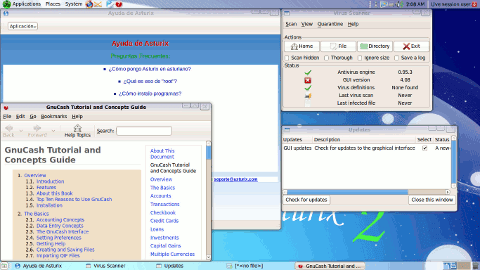
Asturix 2.0 - Getting help and using the virus scanner (full image size: 595kb, screen resolution of 1366x768 pixels)
Conclusions After using Asturix for a week, I found a lot of things, I enjoyed a system that has a lot of items and no others. Glancing at the project in general terms, I think it's a great project, especially aimed at helping English speakers in a variety of environments. A quote, attributed to the English philosopher Jose Ortega y Gasset said: "Excellence means that a man was questioned Mejer or more of themselves than to others." I think that's exactly what developers do, on a basis of Ubuntu, stick with it and adapting to a more specific purpose. I really like your Business edition comes equipped with WINE, Samba, codecs and a virus scanner. Are just those little details that make a distribution to be more attractive to newcomers. Another thing that is very welcome, is the variety of editions tailored to meet different needs as well, giving users flexibility Asturix execution of either low-end machines as the most modern equipment.
Moreover, there are certain points where Asturix does not work. As mentioned earlier, the antivirus is not updated on my computers, and custom package manager does not "feel" to work, or finish the job "would be nice if the installer of the distribution would provide more information to the user what is ( or should not) do.
now, Asturix , is presented as a viable option to encourage those home users to migrate from Microsoft Windows to Linux, and if the project takes the next TLS Ubuntu in the making, as its new base, I think to be able to attract the companies also.
Back to menu

 By
By 

 -Linux has with it a certain ideology: a free, facing the monopoly Microsoft's ...

